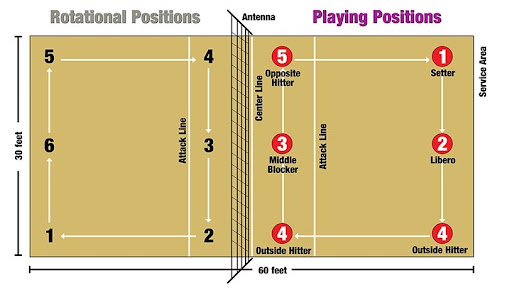
Teams: A volleyball game is typically played between two teams, each consisting of six players on the court at a time.
Each team can have substitutes, but only six players are allowed on the court at once.
Scoring System: Rally Scoring: Points are awarded on every rally (not just when serving).
Matches are usually played to either 25 or 15 points (depending on the format), and a team must win by 2 points.
Sets: A match is played in sets, typically best-of-5. The first team to win 3 sets wins the match.
Rotation: Players must rotate positions in a clockwise direction when their team wins the serve. This means every player will eventually serve and play in different positions.
Serving: The team that wins the rally serves next. The player must serve from behind the end line.
The serve can be overhand or underhand, but it must go over the net and into the opponent's court.
If the ball touches the net but still lands in the opponent’s court, the serve is considered in.
Hits: A team is allowed three touches of the ball (not including a block) before they must send the ball over the net.
Hits include a pass (bump or volley), set, and attack (spike).
Players cannot hit the ball twice in succession, except during a block or the first touch (the ball may touch multiple parts of the body as long as it is a single action).
The Net: A player cannot touch the net with any part of their body during play. A violation results in a point for the other team.
Blocking or attacking the ball near the net is allowed as long as it does not interfere with the opponent's play.
Faults: A fault happens when a team violates a rule, such as:
The ball hitting the ground or going out of bounds.
The ball being hit more than three times before going over the net.
A player touching the net or crossing the centerline.
A player hitting the ball twice in succession.
Attack Hit: An attack hit (or spike) must be executed with a clean and controlled movement. The ball must not be carried or lifted.
The attack hit is typically made by a player near the net, aiming to send the ball forcefully to the opponent's side.
Blocking:A block is a defensive move where players attempt to intercept or deflect the ball coming from an opponent's attack.
A block does not count as one of the team’s three hits.
Time-outs and Substitutions: Teams are allowed to call time-outs (typically 30 seconds) during a set to discuss strategy or rest.
Each team is also allowed a limited number of substitutions during a match.
Libero: The libero is a specialized defensive player who cannot attack the ball above the net or serve.
The libero wears a different color jersey and can replace any back-row player without notifying the referee.
They can only play in the back row and cannot block or attempt to block.